If you’ve spent any time around sound healing, you’ve probably come across charts that assign musical notes to chakras.
The most common version looks something like this:
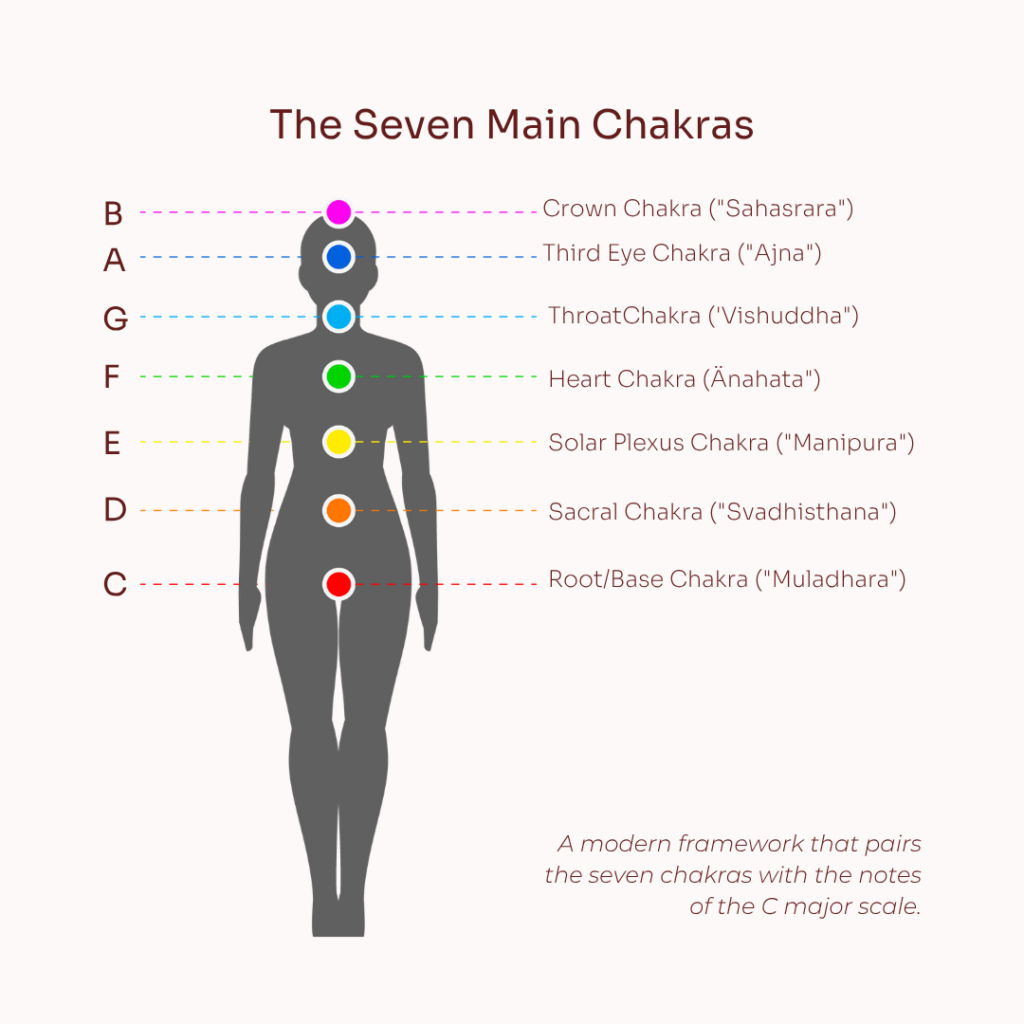
It’s a simple, neat system: seven chakras, seven notes. Easy to remember, easy to teach, and easy to understand.
But where did this idea come from? And is it really an ancient tradition?
The answer might surprise you.
A Modern System, Not an Ancient One
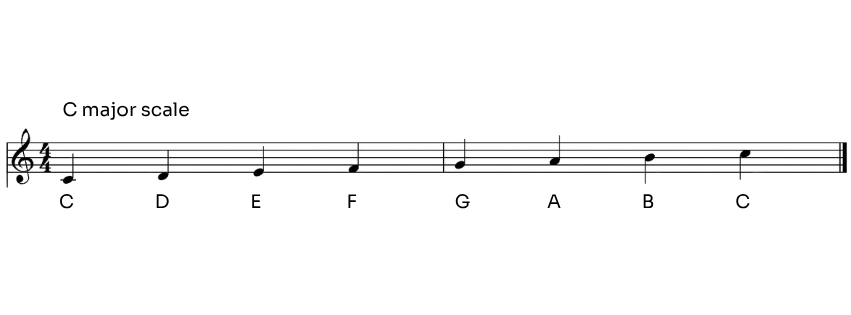
While the chakra system itself has ancient roots in Indian spiritual traditions, the specific system listed above—which pairs the seven chakras with the notes of the C major scale—is a much more recent development based on a framework derived from Western music theory.
Traditional yogic and tantric texts describe chakras using symbolism such as colours, elements, mantras, deities, geometric shapes, and states of consciousness. They do not contain a system linking the chakras to the notes of the Western musical scale, nor is there evidence in the classical chakra texts of a direct one-to-one correspondence between the chakras and any seven-note musical scale or equivalent musical structure.That makes sense when you think about it. The familiar C major scale is a product of Western music theory, while ancient Indian traditions developed their own sophisticated musical systems that evolved independently of the scale most of us learn today.
The familiar note-chakra system is a modern framework rather than an ancient teaching.
This doesn’t make the modern note-chakra system wrong. It simply means we should be honest about where it comes from. Rather than being an ancient teaching, it is better understood as a modern framework that combines ideas from sound, spirituality, energy work, and Western musical concepts.
Why the Idea Became Popular
Part of the appeal is obvious: human beings love patterns.
Seven chakras and seven notes seem to fit together neatly. The system provides structure and gives practitioners and students a simple starting point for exploring the relationship between sound and wellbeing.
For many people, these correspondences create a useful focus for meditation, visualisation, and personal reflection. They provide a framework that can help people engage more deeply with sound-based practices.
And that’s where the conversation becomes more nuanced.
Does It Matter If It’s Historically Inaccurate?
As a sound healing practitioner, I think historical accuracy is important.
Not because we need to dismiss modern approaches, but because integrity matters. If something is a modern interpretation, we should feel comfortable saying so.
At the same time, I don’t believe every useful therapeutic tool must have ancient origins to be valuable. Crystal singing bowls are a good example. Now used extensively in sound therapy, beloved by many practitioners and participants, and producing meaningful results for countless people, crystal singing bowls have only been around for the last 50 years or so.
Many modern wellbeing practices combine ideas from different traditions, psychology, neuroscience, music, and lived experience. Ultimately, the most important question isn’t whether something is ancient. The more important question is whether it is helpful.
The most important question isn’t whether something is ancient. The more important question is whether it is helpful.
Sound Is More Than a Single Note
One of the challenges with rigid note-chakra systems is that they can oversimplify what is actually happening when we experience sound.
When we hear a singing bowl, a gong, a voice, or any acoustic instrument, we’re not hearing a single pure frequency. We’re hearing a rich blend of harmonics, overtones, rhythm, dynamics, resonance, and subtle acoustic interactions.
The experience is also shaped by the environment, the emotional state of the listener, their expectations, memories, associations, and the intention they bring into the experience.
In other words, sound is rarely experienced in isolation. A note is only one small part of a much bigger picture.
The Importance of Intention
This is one reason I don’t completely reject note-chakra associations.
Intention can be a powerful part of any therapeutic process. If a participant chooses to focus on their heart centre while listening to a particular tone, that intention may help shape their experience. The note itself may be only one component of what is happening.
The focus, meaning, attention, and personal significance attached to the experience may all play a role.
In my own work, I will occasionally reference note-chakra associations during a sound session. Not because I believe there is a universal rule that a particular note automatically affects a particular chakra, but because a shared focus can sometimes be helpful.
This can be especially valuable in group settings, where many different individuals are participating in the same experience. A common intention can provide a point of connection while still allowing each person to have their own unique experience.
Honouring Individual Experience
One of the things I love about sound work is that no two people experience it in exactly the same way.
The same sound can evoke completely different responses in different people. A tone that feels grounding to one person may make another person feel light-headed. A sound that reminds one participant of a peaceful memory may bring up something entirely different for someone else.
Because of this, I’m cautious about making absolute claims. I’m also reluctant to dismiss the experiences of others.
If someone consistently experiences a strong connection between a particular note and a particular chakra or body part, that’s their experience. It may be meaningful, transformative, and entirely genuine.
I don’t see any value in arguing someone out of a personal experience that has been helpful to them. At the same time, I don’t think those experiences automatically become universal rules that apply to everybody.
If someone consistently experiences a strong connection between a particular note and a particular chakra or body part, that’s their experience.
A Collaborative Process
For me, this is where the real art of sound healing lies.
As a practitioner, I don’t see effective sound healing as rigidly applying a formula. It’s about paying attention. It’s about observing, listening, adapting, and responding to the person or people in front of you.
Every individual arrives with a different history, nervous system, belief system, and relationship with sound. Every group has its own energy, dynamics, and needs.
The practitioner’s role is not simply to deliver a method. It is to create conditions that support exploration, awareness, relaxation, and wellbeing.
In that sense, sound healing is a collaborative process.
The sounds play an important role. The facilitator plays an important role. But the participant is equally important.
One of the key responsibilities of anyone leading a session is recognising that sound healing is not something that is simply done to a person. The participant’s awareness, openness, intentions, experiences, and responses all contribute to the outcome.
A skilled practitioner creates supportive conditions while remaining attentive to how individuals are engaging with the experience, adapting where appropriate and respecting that each person’s journey with sound will be unique.
My role isn’t to tell people what they should experience.
My role is to create a safe and supportive environment where they can explore their own experience, develop greater awareness, and discover what resonates with them.
Sometimes that may include working with note-chakra associations. Sometimes it may not. What matters most is remaining curious, responsive, and focused on the needs of the individual rather than becoming attached to a particular theory or method.
The experience emerges through the interaction between all of these elements.
My role isn’t to tell people what they should experience. My role is to create a safe and supportive environment where they can explore their own experience and discover what resonates with them.
Final Thoughts
So which note belongs to which chakra?
The honest answer is that there is no universally accepted answer.
The familiar note-chakra system is a modern framework rather than an ancient teaching, and it can be useful when understood in that context.
For some people, these associations provide a meaningful focus for intention and self-exploration. For others, different sounds, frequencies, instruments, or approaches may resonate more strongly.
Rather than asking whether a particular note objectively belongs to a particular chakra, I believe a more useful question is this:
How is the sound being experienced by the person receiving it?
Because ultimately, sound healing isn’t about forcing people into a predetermined system. It’s about using sound thoughtfully, skilfully, and responsively to support the unique human being in front of you.
Natalie Grace is a Sydney-based sound therapist, meditation teacher and educator. She is passionate about combining ancient wisdom, modern understanding, and ethical practice to help people explore the therapeutic potential of sound.