A Sound Healer’s Reflections on Live, Virtual and Recorded Experiences
THE SHORT ANSWER
Yes, a virtual sound bath can support a meaningful experience – but it is not the same experience as sharing live acoustic sound in a room. Its strengths are different, and so are its limits.
A question I had been asking for years
For a long time, I hesitated to offer a virtual sound bath. I can become overwhelmed by technical setup more quickly than I would like to admit, but that was not the real reason. I did not want to offer an inferior version of Sound Flow or lose what feels true to my work.
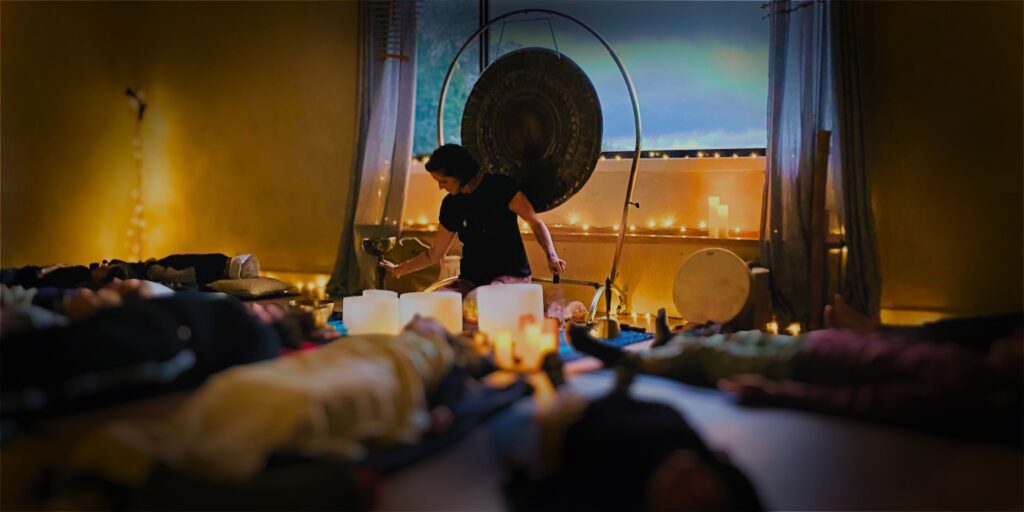
In a room, sound is not simply something we hear. We feel it. A drum can be sensed through the floor. A gong can fill the space with layer upon layer of sound. I move around participants with instruments and respond to what I notice: the collective stillness, a change in breathing, a body shifting, or someone becoming restless. Those small cues help me sense when to build the sound and when to create more space.
As I said during my first Community Preview, “I very much take the vibe of the room.” Online, I may be looking at a screen of little squares, or no faces at all when people choose to turn their cameras off. I receive fewer visual cues, so I rely more on experience, intuition and the structure of the session.
My first online experiments began when COVID changed how we gathered. I was invited to give an online presentation and pre-recorded part of it in advance. Later, a friend and I tried an ambitious collaboration from two locations: voice and bowls at my end, didgeridoo across town. With our limited knowledge of the platform’s audio settings at the time, the sound was awkward and disjointed.
Throughout the period when we could not gather in person, I facilitated interactive online sessions with disability groups using voice and keys, and co-facilitated music-based workshops and experiences. I found that connection and relaxation were still possible even when we were not all in the same room. What held me back from offering a full virtual sound bath was the audio. It simply did not sound close enough to the live experience.
Over time, I felt an increasing nudge to explore online and recorded possibilities properly. I did some research, learned more about recording instruments and invested in new microphones and audio gear. The setup still could not reproduce a live experience, but the improvement was enough for me to invite my community to try a virtual sound bath.
The Community Preview: testing a real question
I was not trying to prove that online was equal to in-person. I wanted to answer a few practical questions. Could people settle and relax at home? Would the bowls, drum and gong come through clearly? Would people who knew my live work still enjoy the experience? And would being at home offer benefits of its own?
I offered a live virtual sound bath to my community and invited feedback afterwards. The response pool was intentionally small; I simply wanted an early sense of how people experienced the session and whether the new equipment delivered clear, enjoyable sound. The feedback was encouraging and gave me confidence to keep exploring.
WHAT CHANGED MY MIND
I stopped asking whether online could reproduce an in-person sound bath. It cannot. I began asking what a carefully designed online experience could offer in its own right.
What participants helped me notice
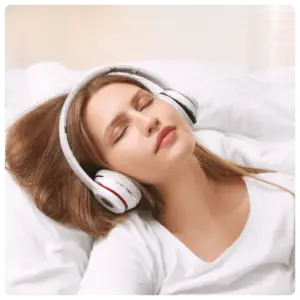
The clearest message was that a virtual sound bath could still feel immersive and relaxing when the sound, setting and facilitation were approached with care.
Feedback confirmed that people appreciated being in the comfort of home and, to my delight, many noted that they felt deeply relaxed by the end of the session. That confirmed one of the format’s genuine strengths: there is no need to gather your belongings, step into traffic or switch straight back into conversation. You are already home, with space to let the experience continue.
Home also gives you more freedom during the session. You can adjust your position, stretch or move without feeling that you are distracting anyone. With cameras off, there is less reason to feel self-conscious – and no need to worry about your own snoring, or anybody else’s. Afterwards, you can stay under the blanket, make a cup of tea, journal or simply fall asleep.
Why live sound baths will remain at the heart of my work
In person, the instruments create sound waves that travel through the room, bounce from the walls and reach the body from different directions. Some sounds, especially lower frequencies, may be consciously felt in the body as well as heard through the ears. Online, microphones capture part of that sound and send it through software, the internet and the listener’s device. Each step can reduce detail, depth and lower frequencies, so the physical sensation is not the same as being in the room.
This is the main limitation of a virtual sound bath: it cannot reproduce the full-body vibration or the feeling of instruments being played around you. Good microphones, stereo sound and quality headphones can create space and movement, but they cannot recreate the room itself.
The connection between facilitator and participant is different too. In person, I can respond to breathing, movement and the overall feeling in the room as the session unfolds. Online, I receive fewer cues. In a recording, I cannot respond at all. That does not make either format without value; it simply means each offers a different experience.
Live, virtual and recorded: three different experiences
| Feature | Live in-person | Live virtual | Recorded / on demand |
| Physical vibration | Full room vibration and sound felt through the body | Some depth and stereo movement; less physical vibration | Some depth and stereo movement; less physical vibration |
| Facilitator response | Responds to the people and room in real time | Responds live, with fewer visual cues | Fixed once recorded |
| Shared atmosphere | People gather in the same space | People share the same time from different places | A private, self-directed experience |
| Access | Requires travel and physical access to a venue | Join from home; helpful across distance or mobility limits | Use at a time that suits you; pause or return |
| After the session | Transition and travel may follow | Remain in your own setting | Choose the time and create your own transition |
| Technology | Minimal for the participant | Internet, platform and playback quality all contribute | Playback device and file quality contribute |
| Best understood as | A shared, whole-body sound experience | A live, guided sound experience at home | A flexible sound experience to use in your own time |
What current evidence can – and cannot – tell us
There is not yet a large body of research comparing virtual and in-person sound baths. Studies use different instruments, session styles and ways of measuring results, so the findings are still developing. I therefore see the research as useful context rather than a final answer.
The wider research on music and stress is encouraging. A 2020 review combined 104 randomised studies involving 9,617 people and found that music-based interventions reduced both people’s reported stress and some physical signs of stress. Another review found that results varied depending on the music, the listener and how stress was measured. That fits my own view: sound can support relaxation, but people will not all respond in the same way.
Research into virtual music therapy also offers a useful comparison, although music therapy and sound therapy are different practices. A recent review found more than 100 papers about music therapy delivered online in recent years. The overall picture is that meaningful music-based support can be offered remotely, while the quality of the technology, the person’s home environment and the connection with the practitioner all affect the experience. This does not prove that an online sound bath is identical to a live one, but it supports the idea that useful sound-based work can happen at a distance.
Attention, imagery and closing the eyes
Research on mental imagery shows that imagining a sound and hearing it are not the same, although some of the same brain networks may be involved. During a virtual sound bath, however, the sound is not imagined: it is real audio being reproduced through speakers or headphones.
I often invite people to close their eyes because it removes the screen and makes it easier to notice the sound, breath and sensations in the body. Research does not show that closing the eyes automatically improves hearing. The benefit here is simpler: there is less to look at and less temptation to watch, so the experience can feel more internal, focused and restful.
Presence, expectation and intention
IIntention has long been central to many sound-healing traditions. Jonathan Goldman, a pioneer in contemporary Western sound therapy, expresses this through his well-known formula, “Frequency + Intention = Healing.” Many practitioners and participants describe intention as an important part of their experience, even though it is difficult to measure and research in a conventional way. For me, intention is the care, attention and purpose I bring to the sounds I create, whether people are in the room or listening from home.
That intention is also expressed in practical ways: how I welcome people, guide them into relaxation, choose and pace the instruments, and help them feel safe and unhurried. These elements can travel online because they are built into the way the session is facilitated.
WHY INTENTION STILL COUNTS
For me, intention is not an abstract promise. It is expressed through preparation, presence, careful listening and the way I guide people through the experience – online as well as in person.
Does the playback device make a difference?
For me, the playback device makes a big difference. I was genuinely surprised to receive positive feedback from people who listened through their device speakers, because I expected the experience to depend more heavily on headphones. It showed me that simple equipment can still work in a quiet space, but good playback gives the instruments far more depth and clarity.
Phone and laptop speakers are designed mainly for convenience and speech, so the deeper tones of bowls, drums and gongs may sound thinner. External stereo speakers can give a fuller, more spacious sound. My preference is good-quality over-ear headphones: they cover the ears, help reduce household distractions and make it easier to hear how sounds move between left and right. They are also often more comfortable than earbuds for a longer session, although comfort is personal.
Noise-cancelling headphones can be especially helpful when background sounds cannot be avoided – family moving around, traffic outside or an air conditioner humming. By reducing that noise, they can help you hear clearly without turning the volume up. Whatever you use, keep the volume comfortable; louder is neither safer nor more effective.
| Playback option | Strengths | Limitations | My guidance |
| Phone speaker | Immediate and simple | Least bass, no perceived movement of sound, easily masked by room noise | Use only if it is the only comfortable option; place nearby, not against the ear |
| Laptop / tablet speakers | Convenient; may be fuller than a phone | Still limited in bass and stereo width | Choose a quiet room and test speech clarity first |
| External stereo speakers | Open sound; no pressure around the ears | Room acoustics and household noise remain audible | Position evenly, preferably at ear (head)-height; keep volume gentle |
| Earbuds | Portable and can isolate well | Fit and comfort vary; some people dislike long in-ear listening | Use a secure, comfortable fit and conservative volume |
| Over-ear headphones | Good isolation, stereo detail and often comfortable for longer listening | Can feel warm or heavy; model quality varies | My preferred option, especially with noise cancellation in a busy location |
How to prepare for a virtual sound bath – a listener’s guide
You do not need expensive equipment or an elaborate setup. A few simple choices can make the session more comfortable and reduce distractions.

- If joining live, arrive a few minutes early so you can check the link, mute your microphone and settle before the session begins.
- Choose a quiet, comfortable place and use the best listening option you have. Silence notifications and let anyone nearby know when you expect to finish.
- Set the volume during the introduction or opening guided relaxation, when the facilitator’s voice is easy to hear. Keep it at a comfortable level and avoid turning it up for quieter passages, as instruments can become louder without warning.
- Sit or lie down – whichever feels best. Use cushions, a bolster or a rolled blanket to support your head, neck, back or knees, and keep a blanket nearby if the room is cool.
- Keep your camera on or off according to your preference. You do not need to watch the screen once the session begins. In fact, it’s advisable to close your eyes.
- Move, adjust your position or stop at any time. You remain in charge of your body and your environment throughout the session.
- If possible, leave a few quiet minutes afterwards before moving into your next activity.
SAFETY FIRST
Do not listen while driving or operating equipment. Keep volume comfortable. If you have tinnitus, sound sensitivity, hearing concerns, epilepsy triggered by sensory stimuli, significant trauma responses, or another condition that could affect participation, seek appropriate professional advice and contact the facilitator before the session. Stop if you feel unwell.
The facilitator’s side of the screen
A successful online session starts well before anyone clicks the link. Microphone choice and placement affect whether delicate overtones, deeper tones and sudden peaks are captured clearly. Video-conferencing platforms are usually designed for speech, so their automatic settings can flatten sustained instruments or make the sound cut in and out. Internet quality and the listener’s device add further variables.
This is why I took time to improve my setup. I was not trying to recreate a professional studio in every participant’s home. I wanted the instruments to sound clear, natural and balanced, with enough room for both quiet passages and the power of the gong or drum.
The way I guide the session is equally important. As in all my sessions, I begin with a spoken guided relaxation and finish with a slow, gradual return to an alert state. Cameras are optional, movement is welcome and participants remain in charge of their own comfort. That familiar structure helps the online experience feel complete rather than ending abruptly when the meeting closes.
So, can a virtual sound bath really work?
If by “work” we mean perfectly reproduce the physical and relational qualities of an in-person sound bath, my answer is no. If we mean create conditions in which some people can settle, listen deeply, feel connected and experience genuine relaxation, my answer is yes – with thoughtful facilitation, careful audio and realistic expectations.
My experience with virtual sessions has not changed how strongly I value being together in person. It has helped me see more clearly what live sessions offer, while also showing me why online access can be valuable for people who live further away, have mobility or transport constraints, are caring for family, feel safer at home or simply enjoy being able to remain in their own space afterwards.
People have used sound and music recordings for relaxation for many years. A recording removes the shared live moment and my ability to respond in real time, but the listener can choose when to use it and return to it whenever they wish. The therapeutic and relaxing qualities of sound can still be experienced through a recording, even though the format is different.
Live, in-person Sound Flow sessions will remain at the heart of what I do because connecting with people in the room and sharing the physical sound of the instruments is deeply important to me. Virtual and recorded experiences will not replace that. They can sit alongside live sessions as accessible, flexible and genuinely relaxing ways to experience Sound Flow at home.
WHERE TO FROM HERE?
I will share future online sessions, recordings and reflections with the Sound Flow community. In the meantime, live Sound Flow sessions are continuing as always.
Join the Sound Flow community to receive our monthly newsletter.
References and further reading
de Witte, M., Spruit, A., van Hooren, S., Moonen, X., & Stams, G. J. (2020). Effects of music interventions on stress-related outcomes: A systematic review and two meta-analyses. Health Psychology Review, 14(2), 294-324. https://doi.org/10.1080/17437199.2019.1627897
Kiss, L., Linnell, K. J., et al. (2022). Music listening and stress recovery in healthy individuals: A systematic review with meta-analysis of experimental studies. PLOS ONE, 17(6), e0270031. https://doi.org/10.1371/journal.pone.0270031
Goldman, J., Goldman, A., & Beaulieu, J. (2017). The Humming Effect: Sound Healing for Health and Happiness. Healing Arts Press. (Includes the authors’ formula, ‘Frequency + Intent = Healing.’)
Wöstmann, M., Schmitt, L.-M., & Obleser, J. (2020). Does closing the eyes enhance auditory attention? Eye closure increases attentional alpha-power modulation but not listening performance. Journal of Cognitive Neuroscience, 32(2), 212-225. https://doi.org/10.1162/jocn_a_01403
World Health Organization. (2026). Deafness and hearing loss: Safe listening. https://www.who.int/news-room/questions-and-answers/item/deafness-and-hearing-loss-safe-listening
Virtual music therapy during the COVID-19 pandemic: An updated scoping review. (2026). PubMed record PMID 41987698. https://pubmed.ncbi.nlm.nih.gov/41987698/